
'...especially pressure on the rupee, the current account deficit, and foreign exchange outflows.' 'The key question over the next several months is whether the government can prevent external turbulence from feeding into domestic economic pessimism.'
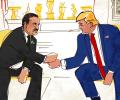
'Trump has personally weighed in to overcome doubts and reservations about Pakistan among his top advisors.'

'When compared to many of America's treaty allies in Asia, Modi 3.0 is on a much stronger footing.'

The 'aura of invincibility' around Prime Minister Narendra Modi has been 'shattered' by the Indian voters who gave the Opposition a new lease on life, this is how the international media described the outcome of India's general elections.

The author of a definitive guide to the Kashmir crisis speaks with Managing Editor Aziz Haniffa.
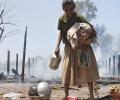
Hindu American Foundation: 'As an organisation that works on issues affecting Hindu minorities... in the civil war although all groups were affected, Hindu temples and Hindu institutions were disproportionately affected, and Hindus continue to be affected.' Sri Lanka's Ambassador to the United States Prasad Kariyawasam: 'Assume that Sri Lanka is referred to the ICC through the UN Security Council -- which will never happen because Sri Lanka has enough clout to block it. But assume it is. Still, the ICC cannot handle it because retrospectively they don't have jurisdiction.'
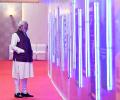
Despite all of the PM's many strengths, it is increasingly clear that he does not necessarily have a coherent and clear worldview on matters of macro policy.

'There are three pillars of concern: The expansion of Hindu majoritarianism, the concentration of executive power and decay of independent institutions, and curbs on free expression and dissent.'

Describing the Narendra Modi-led BJP's electoral victory as a "breathtaking landslide", eminent American think tanks and experts have said the win has given him an opportunity to "redefine" Indian politics.
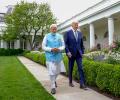
'India will want a lot of help from the US, but it's not going to want US troops.'

'The crisis has strengthened America's resolve to work towards building its relationship with India as a bulwark against Chinese aggression'

For India to reach its ambiguous economic growth targets, it needs to be integrated into global trade pacts.
If India takes care of the economic investments, then it will open up the space to dampen or circumvent some of the political burdens
'Potent nationalism doesn't just distract from the economic task at hand; it actively undermines it.'

Days before Narendra Modi arrives in the US to speak at the UN, meet Barack Obama, gupshup with the likes of Nadella, Pichai, Zuckerberg, and address desis in Silicon Valley, his ministers will help set the commercial and strategic tone for the prime minister's visit.

Prime Minister Narendra Modi has indicated that he wants to take India's relationship with America to a new direction by inviting US President Barack Obama as Republic Day chief guest, despite having the bitter experience of a visa ban for 10 years, experts have said.

The beauty of the relationship between the two countries is that they agree to disagree and perhaps that is the strongest bond between the two governments and their relationships, notes Rup Narayan Das.

Experts said the tensions have added to a sense of apprehension in the United States, Europe and parts of Asia that China will engage in more aggressive behaviour in pursuit of its territorial interests, which in turn has raised the possibility of a serious and coordinated pushback by leading global players.

In the light of India's increasingly 'darkening' threat environment and the convergence of strategic interests between China and Pakistan, the IAF's declining combat capabilities are a cause for concern, says Brigadier Gurmeet Kanwal (retd).

The Obama administration has christened his vision of Indo-US ties that has overcome the "hesitations of history" and working for the betterment of the global good as "Modi Doctrine".

Defining challenge in India is augmenting state capacity, says Finance Minister P Chidambaram.
"If there is proper debate in parliament, followed by a vote, then even without the Congress' support, we have a chance to pass it," says Union Minister of State for Finance, Jayant Sinha.

Finance Minister P Chidambaram, while addressing the Carnegie Endowment for International Peace on "Recapturing India's Growth Momentum" in Washington on Thursday, said that the leading think tank need not launch an initiative to explore how India will vote in 2014, declaring that the Indian polity will vote the Congress back into power.

'We want to provide data, we want to provide consultation, but we don't want to lecture.' 'The consciousness about this issue in India is starting to get quite high and if we can help contribute to solving this air quality issue in a spirit of partnership with the Indians, it would be a big achievement.'

'Deep pockets have become a prerequisite for contesting elections on a major party symbol in most states.' 'Given the premium parties place on self-financing candidates, once you have accounted for the suspected criminals, dynasts, industrialists, and celebrities, there is not much room for anyone else.'

'Modi is still immensely popular and, therefore, he can sustain any number of policy failures.' 'Modi himself has worn multiple faces so it would be naive to think that the Modi of 2021 will be the same Modi that will be campaigning for re-election in 2024.'

India's demographic dividend may not automatically give rise to tangible economic gains -- at least not with immediate effect -- but it is likely to have a big impact on the coming Lok Sabha elections, Mayank Mishra

'Despite the BJP's successes at the state-level, replicating their 282-seat majority in 2019 is going to be an uphill climb.'

Leading think tank discusses a likely Narendra Modi government and America's engagement with the man US once scorned. Aziz Haniffa reports

'The US wants Modi to succeed because we want India to succeed. For our part, when India thinks of its partners in the world, we want it to think of the US first. That means positioning our country as the preferred provider of the key inputs that can help to propel India's rise.' 'The meeting between Modi and Obama is, and must be, an opportunity for true strategic dialogue -- not a scripted exchange of talking points, but an open discussion of the big questions. What kind of world do we want to live in? What are our true priorities? And most importantly, why does this partnership still matter?'

Any attempt to defang Islamic State must first cut off its main sources of funding, especially its revenue from oil sales, extortion and crime, ransom payments, and support from foreign donors. This will also be need to be backed up by efficient forces on the ground.

'If Indian armed forces entered Pakistan and succeeded in inflicting major damage on the Pakistani army and occupied territory in the Pakistani heartland, there is reason to think the Pakistani military would use some nuclear weapons against the incoming Indian forces to compel India to stop.'

The Indian Spring represented by Anna Hazare's anti-corruption campaign, which has culminated in the Aam Aadmi Party's impressive electoral debut in New Delhi, began around the same time as the Arab Spring in 2011 but they led to different outcomes in India and the Arab world, says Ramesh Ramachandran.

'When he first came to office, my belief is that the PM's reading of the landscape was that, with a vanquished Congress and fragmented Opposition, he was looking at least at two terms in office. This reading perhaps allows for a more cautious, gradual approach.' 'It was only a matter of time before the government was forced to come face-to-face with a serious corruption scandal. This is not a commentary on the BJP, but a statement about India's political economy.' 'There is growing concern about the government's commitment to freedom of expression, religious tolerance, and an independent civil society. Thus far, the positive movement on strategic and economic matters has crowded out these concerns, but they are lingering beneath the surface.'
 © 2026 Rediff.com - Advertise with us - Disclaimer - Privacy Policy - Sitemap - Feedback - About us - Terms of use - Grievances